Go cold turkey
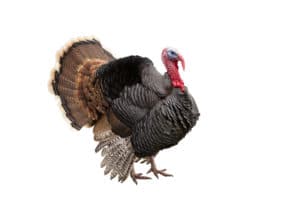
Sound weird? Well, you’re right, it does, how can anyone literally go cold turkey? A person can’t transform into the bird we all love to eat for celebrations such as Christmas and Thanksgiving.
The origins of this English idiom are strange and to go cold turkey means to suddenly quit or stop addictive or dangerous behavior such as smoking or drinking alcohol.
This English idiom is said to have originated in the late 20th century and suggests that a person who suddenly quits something addictive—such as drugs or alcohol—suffers from side effects that look like a cold, uncooked turkey. This includes pale (very white) skin and goosebumps (little small bumps on the skin when we’re cold or sick).
“Shall I get your mom a glass of wine?”
“No, she’s stopped drinking?”
“Really, why?”
“I don’t know. A few months ago, she just announced one day she’s quitting drinking.”
“She just quit cold turkey?”
“Yes, just like that!”
1 Alice isn’t interested in (look) looking for a new job.
2 Henry is excited (leave) for India.
3 You are capable (do) better work.
4 I have no excuse (be) late.
5 I’m accustomed (have) a big breakfast.
6 The rain prevented us (complete) the work.
7 Fred is always complaining (have) a headache.
8 Instead (study) , Margaret went to a ball game with some of her friends.
9 Thank you (help) me carry the packages to the post office.
10 Mrs. Grant insisted (know) the whole truth.
11 He showed us how to get to his house (draw) a map.
12 You should take advantage (live) here.
13 Laura had a good reason (go, not) to class yesterday.
14 Everyone in the neighborhood participated (search) for the lost child.
15 I apologized to Diane (make) her wait for me.
Even native speakers of English sometimes have problems with although and though, but the words are really not that difficult to use.
Is there a difference in meaning?
No, there isn’t. Although and though have the same meaning and are interchangeable in most cases.
Examples
Here are some examples which show us how we can use either word:
- Although/though the sun was shining, it was very cold.
- He disagreed with us, although/though he didn’t tell us.
- The house is lovely, although/though the garden is a bit small.
When are although and though NOT interchangeable?
There are three cases when you can use though but NOT although:
1. At the end of a sentence (used in spoken English):
- He disagreed with us. He didn’t tell us, though.
- The house is lovely. The garden is a bit small, though.
2. With as (meaning as if):
- It sounds as though/as if you had a nice holiday.
- He acted as though/as if nothing was wrong.
3. With even (to add emphasis):
- Even though Arsenal played well, they lost the game.
- I took my coat, even though it wasn’t cold.
! Remember that although is a little more formal than though. We often use although in written English and though in spoken English.
! Even though is a stronger form of although.
Got it? Now test yourself with this short exercise:
1 I see her every day on the train. I've never spoken to her, . 
2 , I managed to order food in the restaurants in Madrid.
3 Even he's lived in London for two years, he doesn't know the city very well.
4 With the score at 2-0 it looked we were going to win but we ended up losing the match 4-2.
5 We went to Hollywood last year. We didn't see any movie stars, .
6 I prefer to go by public transport even it's sometimes faster to go by car.

Комментариев нет:
Отправить комментарий