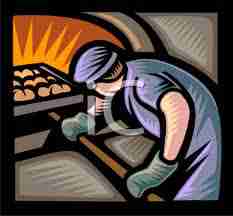
to cook in an oven without extra fat, especially bread, cakes, pastries.
a baker
baked potatoes
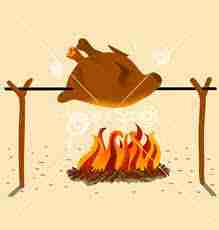
to roast
to cook, especially meat, in an oven or over a fire.to roast
to roast coffee beans
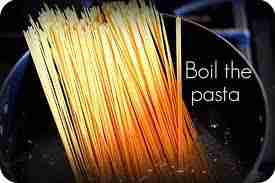
to boil
to cook in boiling water (100 °C)
to boil down To cook pasta put them in boiling water and stir. If you don't stir during the first moments of cooking they will stick together. to stir to stick
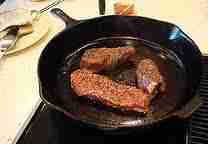
to fry
to cook food in hot oil, or fat To cook chips (French fries US) you use a deep fryer. You fry a steak in a frying-pan.
A steak can be cooked 'rare' 'medium' or 'well done'
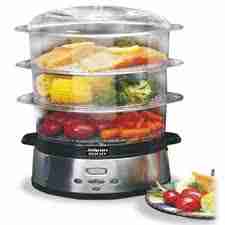
to steam
to cook food by heating it in the steam from boiling water
The most healthy way to prepare vegetables is to steam them. To steam vegetables you can use a steaming basket over boiling water. (a container with holes on the bottom)
or a steam cooker
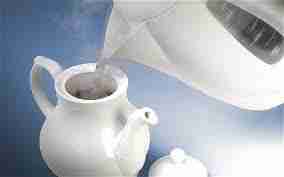
To simmer
to cook something slowly in hot liquid kept at or just below the boiling point.(85 °C / 95 ° C)
to make tea pour simmering water over the tealeaves.
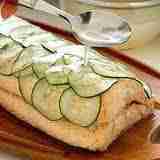
to poach
to cook an item by submerging it in a liquid that is just bareley simmering.(75 °C / 85 °C)
The easiest way to prepare delicious salmon steaks or fillets is to poach them in white wine seasoned with fresh dill. to season dill
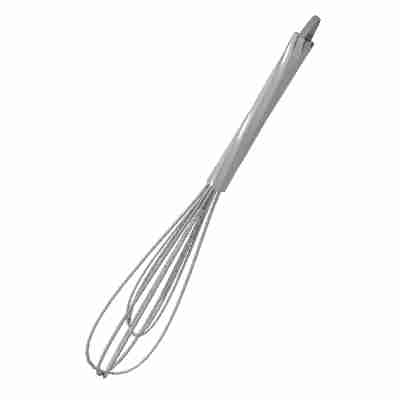
to whisk
to stir-fry
to flip over
How to cook an egg?
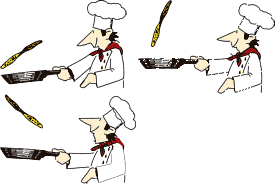
According to the legend the 100 folds of the chef's hat (toque) are said to represent the many different ways he knows to cook an egg. I don't know if there are really 100 different ways to cook an egg but you can read below some of these ways.
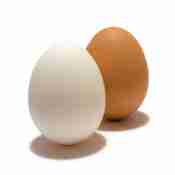
An egg contains a yolk and a white enclosed in a shell. yolk shell
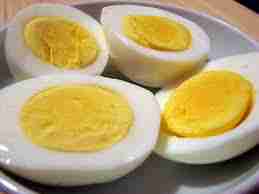
Ahard-boiledegg
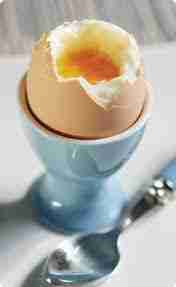
Asoft-boiledegg in an eggcup
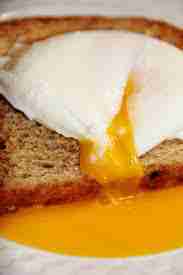
A poachedegg
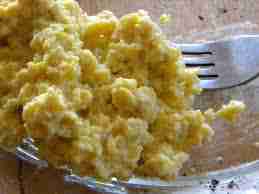
A scrambledegg
Cook for 10 minutes in boiling water.
Cook for 3 minutes in boiling water.
Crack an egg and cook for 3-5 min. in water at about 80 °C
Fry a whisked egg in a pan. Stir while it is cooking.
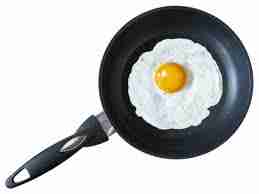
A sunny-side up egg
Anover-easyegg
Anover-hardegg
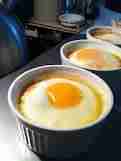
Ashirredegg (or baked egg)
Fry in a pan with yolk left runny. (le jaune reste liquide)
Flip the egg over and fry the other side for a few seconds.
Flip the egg over and fry the second side until the yolk is solid.
Bake the egg into a greased ramekin until the yolk begins to thicken.
Since yesterday I try to write my essay to sum up documents on GMO but I don't have lots of inspiration. I have some difficulties to develop my notes. I gonna try again just before our lesson, sorry to havn't sent my homework before.
GMO foods are genetically modified organisms that have had new genes from other organisms added to their existing genes, according to Brown University. The university says the goal of such genetic engineering is to give the original organism new characteristics, such as disease resistance. Although GMO foods may have several benefits to your health and the general well-being of the farming industry, it may also present several potential drawbacks.
CONS: ALLERGIC REACTIONS
GMO foods can present significant allergy risks to people, according to Brown University. Genetic modification often mixes or adds proteins that weren't indigenous to the original plant or animal, causing new allergic reactions in the human body. In some cases, proteins from an organism that you're allergic to may be added to an organism that you weren't originally allergic to, prompting the same allergic reaction experienced from the first organism.
PROS: INSECT RESISTANCE
Some GMO foods have been modified to make them more resistant to insect pests. The University of California in San Diego reports that a toxic bacterium can be added to crops to make them insect repellent, yet safe for human use. This can reduce the amount of pesticide chemicals used on the plants, thus potentially reducing exposure to pesticides.
CONS: DECREASED ANTIBIOTIC EFFICACY
Some GMO foods have had antibiotic features built into them to make them immune or resistant to diseases or viruses, according to Iowa State University. When you eat them, these antibiotic markers persist in your body and can make actual antibiotic medications less effective. The university warns that such ingestion of GMO foods and regular exposure to antibiotics may be contributing to the decreased effectiveness of antibiotic drugs that is being noticed in hospitals around the world.
PROS: ENVIRONMENTAL PROTECTION
Oklahoma State University reports that the increase of GMO crops and animals often requires less chemicals, time and tools, and may help to reduce environmental pollution, greenhouse gas emissions and soil erosion. This can improve the general beauty and health of the environment surrounding farms and contribute to the sustaining of better air and water quality, which can indirectly benefit your personal well-being.
This video is talking about a big
problem at one of the London's airports. It was a very bad day for the most of the people
came to take a flight. They couldn't flight because of a computer problem in the air trafic control.
More and more people were
waiting because their flight
were canceled. So they hoped to find a new flight and decided to wait in the
queue during several hours. Others were waiting in having a snack or spendind their time outside.
In the Airport it was getting
hoter and hoter because of the sunny day and the amount of people, there were
very bad conditions to wait and solve the problem, espacially for old people and children. Airport staff was overtaken
by events and just gave water and chairs to help travelers to support this bad moment.
Most, the most, mostly
We use most with nouns to mean ‘the majority of’
She plays tennis most mornings.
Most tap water is drinkable.
When we are talking about the majority of something in general, we use most + noun. When we are talking about the majority of a specific set of something, we use most of the + noun.
Compare
Most desserts are sweet.
Desserts in general
The food at the party was delicious. He’d made most of the desserts himself.
A specific set of desserts (at the party)
When we usemostbefore articles (a/an, the), demonstratives (this, that), possessives (my, your) or pronouns (him, them), we needof:
Most of the information was useful. Some of it wasn’t relevant.
Not: Most the information …
Warning:
When there is no article, demonstrative or possessive pronoun, we don’t usually use of:
There hasn’t been much rain. Most rivers are below their normal levels.
Not: Most of rivers are below their normal levels.
We use most of before geographical names:
[from a weather forecast]
Most of England and Wales should be dry throughout the day
We can leave out the noun with most when the noun is obvious:
[talking about school lunches]
Some children brought a packed lunch but most had a cooked meal in the canteen.(most children)
The most
The most is the superlative form of many, much. We use the most with different classes of words.
The most with adjectives and adverbs
We use the most to make the superlative forms of longer adjectives and the majority of adverbs:
They’re using the most advanced technology in the world. (+ adjective)
[the Lake District is an area in Britain]
Scafell Pike is the most easily identifiable peak in the Lake District.(+ adverb)
The most with a noun
We use the most with a noun to mean ‘more/less than all of the others’:
Ian earns the most money in our family.
We can leave out the noun when it is obvious:
He didn’t tell the best jokes but he told the most. (the most jokes)