/ε/ and /æ/
The man bought a house.
The men bought a house.
1 2
/ε/ /æ/
men man
bet bat
set sat
ten tan
Practice the following sentences. The underlined parts of the words contain the sound /ε/.
a) My friend bought a pen.
b) There are ten pencils on the desk.
c) The men are coming at seven.
d) Where is the letter?
e) I left it on the desk.
4. Practice the following sentences. The underlined parts of the words contain the sound /æ/.
a) The man sat down.
b) What do you have in your hand?
c) It"s a black hat.
d) His hand was badly cut.
e) I"m going to the bank this afternoon.
f) The blackboard is in front of the class.
g) The cat ate a rat
h) The man owns some land.
 "Joe is chasing the bus."


"Kevin wants some ice-cream."
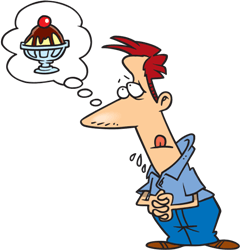
Non-continuous verbs are verbs that we do not normally use with continuous tenses. These "stative" verbs are about state, not action, and they cannot express the continuous or progressive aspect. Here are some of the most common non-continuous verbs:
- feeling: hate, like, love, prefer, want, wish
- senses: appear, feel, hear, see, seem, smell, sound, taste
- communication: agree, deny, disagree, mean, promise, satisfy, surprise
- thinking: believe, imagine, know, mean, realize, recognize, remember, understand
- other states: be, belong, concern, depend, involve, matter, need, owe, own, possess
Look at these example sentences, right and wrong:
| I want a coffee. | not |
| I don't believe you are right. | not |
| Does this pen belong to you? | not |
| It seemed wrong. | not |
| I don't hear anything. | not |
Notice that we often use can + see/hear:
- I can see someone in the distance. not
I am seeing someone in the distance. - I can't hear you very well. not
I am not hearing you very well.
With verbs that we cannot use in continuous tenses, there is no real action or activity. Compare hear and listen. The verb "hear" means "receive sound in your ears". There is no action or activity by you. We cannot use hear with continuous tenses. But listenmeans "try to hear". You make an effort to hear. There is a kind of action or activity. We can use listen with continuous tenses.
Some verbs can be both stative and dynamic:
| Be |
be is usually a stative verb, but when it is used in the continuous it means 'behaving' or 'acting'
|
| Think |
|
| Have |
|
| See |
|
| Taste |
|

Комментариев нет:
Отправить комментарий